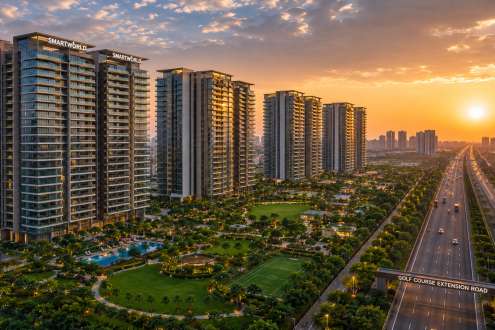

BUILDING CONSTRUCTION COST PER SQ. FT. IN INDIA 2026

07/16/2026
PROPTECH ADVISORY | REAL ESTATE INTELLIGENCE | GURUGRAM

www.ssestateanalytica.com | +91 97181 11251

STRATEGIC PROPTECH ADVISORY BRIEF | JULY 2026

A Forensic Work-Wise Breakdown, Material Specification Matrix, and Corridor-Level Value Sourcing Analysis for Private Portfolios

  • Core Sourcing Thesis: Balancing structural integrity against variable finishing specifications to maximize return on investment (ROI) while avoiding over-priced launch assets.
  • Geographic Focus: Pan-India macro baselines with high-velocity data splicing optimized for the Delhi-NCR / Gurugram development landscape.
  • Target Inventory Tiers: Economy baseline construction, mainstream Standard residential formats, and bespoke Premium luxury specifications.
  • Prepared By: Research & Strategy Team, SS Estate Analytica | Business Head: Manish Kumar.
  • Classification: Public Digital Sourcing Intelligence & Client Portfolio Briefing.

EXECUTIVE SUMMARY

Deconstructing the true building construction cost per sq. ft. in India for 2026 serves as an essential foundation for property allocators, private land bankers, self-builders, and developers managing high-end residential assets. Driven by rapid infrastructure expansions along primary growth zones—such as the Dwarka Expressway corridor and the upcoming Jewar Airport network—the price architecture of structural raw materials and professional labor faces ongoing adjustments. For modern portfolios, independent cost authentication serves as a powerful shield against speculative developer premiums, ensuring that deployment choices align perfectly with long-term wealth stability.

Across the 2026 construction landscape, pan-India baseline parameters settle into three distinct tiers: Economy builds scaling from ₹1,400 to ₹1,900 per sq. ft., Standard residential builds ranging from ₹1,900 to ₹2,800 per sq. ft., and Premium luxury configurations moving from ₹3,000 to ₹5,000+ per sq. ft.. Within high-velocity sub-markets like Delhi-NCR, local market conditions naturally elevate these baselines by approximately 10% to 20%, driven by rigorous green clearance demands, structural load parameters, and specialized compliance standards. This institutional guide delivers an unedited financial blueprint of work-wise budget allocations, tracks structural vs. finishing cost curves, and highlights strategic cost optimization plays engineered to preserve capital efficiency.

📥 Quick Sourcing Catalog Download:

Short on time? Instantly receive the complete unedited printout copy of this entire 2026 budget matrix, “SS_Estate_Analytica_India_Construction_Cost_Guide.pdf”, sent directly to your WhatsApp.

💬 Request Full Construction Cost PDF via WhatsApp

1. 2026 PAN-INDIA BUILDING CONSTRUCTION COST TIER MATRIX

The table below breaks down current 2026 construction realities across the domestic ecosystem. Actual project delivery costs vary based on municipal regulatory clearance layers (RERA, environmental mandates, fire protection rules), architectural complexity, soil load limits, and structural material selections:

Technical Specification & Sourcing Allocation Grid (Indicative 2026 Base)

Project Asset CategoryBlended Cost Range (₹ / Sq. Ft.)Definitive Structural Specifications & Targeted Asset Alignment
1. Basic Building (Economy Tier)₹1,400 – ₹1,900Reinforced Cement Concrete (RCC) skeletal frame paired with localized baseline finishing assets. Best suited for affordable housing schemes, core-and-shell development layers, and Tier-2/3 perimeter expansions. Offers the fastest turnaround times but limits long-term capital re-rating limits.
2. Standard Building (Mainstream Tier)₹1,900 – ₹2,800High-grade certified structural cement, premium brand steel rebar, vitrified flooring configurations, copper modular electrical lines, and weather-shield coats. The optimal benchmark for core residential housing in Delhi-NCR, delivering an excellent balance of durability and resale value.
3. Premium Building (Luxury Tier)₹3,000 – ₹5,000+Architectural stone work, imported marble slabs, premium designer fixtures, specialized multi-layer waterproofing, integrated smart home protocols, and eco-certified materials. Targeted for bespoke luxury villas and iconic branded residences facing primary transit corridors.

Delhi-NCR Corridor Note: Within primary growth corridors like the Dwarka Expressway, intense localized demand and stringent structural safety layers push the true operational baseline for Standard projects closer to ₹2,100 to ₹2,400 per sq. ft., while Premium luxury skyscrapers comfortably exceed ₹3,500 to ₹4,500+ per sq. ft. in direct construction spending.

2. APPROXIMATE WORK-WISE COST ALLOCATION BREAKDOWN

To assist contractors and portfolios in tracking budget allocations and maximizing structural safety, this detailed work-item matrix maps the 2026 per-square-foot cost weights:

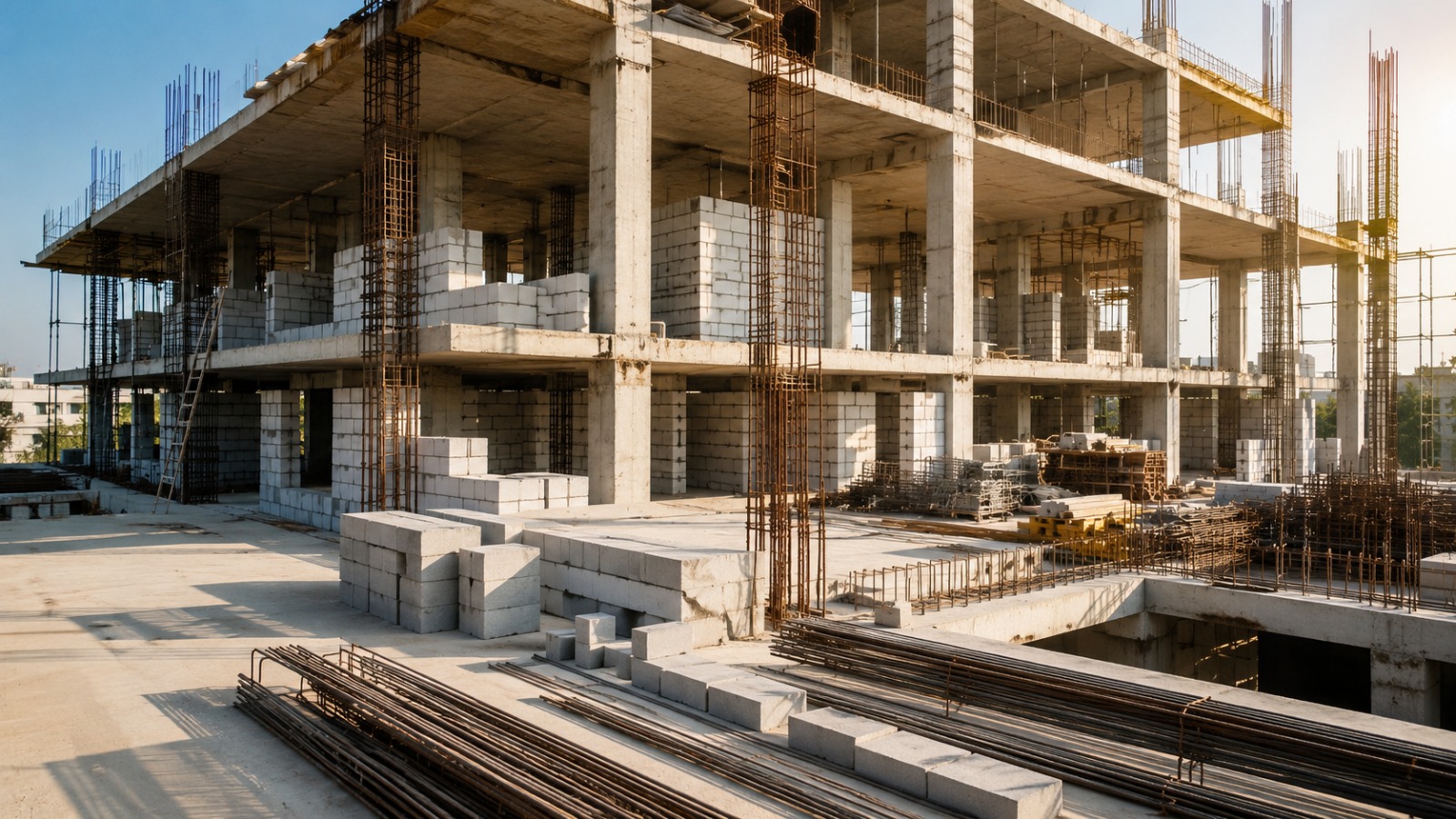
  • Foundation & Earthwork (₹150 – ₹300 / sq. ft.): Highly critical across northern alluvial plains due to varying water table depths. Demands rigorous soil testing inputs to eliminate foundational structural risks.
  • RCC Structure — Columns, Beams, Slabs (₹600 – ₹900 / sq. ft.): Explodes as the single largest cost center, absorbing ~35% to 40% of total project expenditures. Structural integrity demands high steel rebar sizing and precise concrete mix execution.
  • Brickwork & AAC Block Masonry (₹200 – ₹350 / sq. ft.): Autoclaved Aerated Concrete (AAC) blocks emerge as the modern preferred choice to optimize construction timelines and provide enhanced thermal insulation.
  • Plaster Work Blocks (₹100 – ₹200 / sq. ft.): Covers internal smoothing and external protective coats. Premium installations use smooth gypsum interior layers to minimize future paint consumption.
  • Flooring & Tile Finishes (₹150 – ₹400 / sq. ft.): A highly variable design element. Standard metrics deploy vitrified anti-skid formats, while luxury tiers feature large-format imported marble.
  • Plumbing & Sanitary Systems (₹100 – ₹250 / sq. ft.): Leverages durable CPVC/UPVC pipe networks to completely protect structural lines from internal moisture leakage risks.
  • Electrical Infrastructure (₹100 – ₹300 / sq. ft.): Integrates multi-strand fire-retardant copper wiring, centralized modular distribution units, and essential provisions for smart automation or EV charging grids.
  • Doors & Architectural Windows (₹150 – ₹400 / sq. ft.): Strong shift toward high-performance UPVC or specialized double-glazed aluminum profiles to handle regional temperature swings, while luxury spaces use premium engineered timber.
  • Painting & External Emulsions (₹80 – ₹200 / sq. ft.): High-performance weatherproof external acrylic boundaries paired with premium interior emulsions deliver immediate visual appeal at modest budget weights.
  • Forensic Waterproofing Moats (₹50 – ₹150 / sq. ft.): Often under-budgeted but highly critical for terraces, low-grade retaining walls, and wet areas to completely block seasonal moisture penetration and prevent expensive future repairs.
  • External Infrastructure Fields (Additional Layer): Secondary structural extensions including boundary walls, access driveways, professional landscaping layout trims, and solar array mounting add roughly 8% to 15% to the primary structural budget.
  [THE PRODUCTION CAKE] ──► 45% - 50% Structural Matrix (Foundation + RCC Frame + Masonry)
                        ──► 30% - 35% Finishing Elements (Flooring + Openings + Paint layers)
                        ──► 12% - 15% MEP Engineering (Plumbing + Electrical Infrastructure)

3. REAL-WORLD COST CONVERSION SCENARIOS

To visualize how these per-square-foot cost allocations translate into concrete real-world budgets, consider these verified 2026 mathematical models:

Scenario A: The 1,000 Sq. Ft. Standard Family Layout

  • Total Base Valuation: ~₹22,000,000 (Assuming an optimized baseline index of ₹2,200 per sq. ft.).
  • Work Breakdown: Foundation allocations command ₹1.5 Lakh; the core RCC skeletal structure absorbs ₹7.5 Lakh; masonry blocks take ₹2.75 Lakh; internal plaster tracks at ₹1.5 Lakh; flooring systems scale to ₹2.75 Lakh; plumbing and electrical systems take ₹1.75 Lakh and ₹2 Lakh respectively; windows/openings take ₹2.75 Lakh; while painting and waterproofing layers absorb the final ₹1.4 Lakh and ₹1 Lakh blocks.

Scenario B: The 2,000 Sq. Ft. Suburban Plotted Configuration

  • Standard Build Framework: Scales linearly to range between ₹38 Lakh and ₹55 Lakh all-inclusive, presenting the standard benchmark across growing residential nodes like Sohna and New Gurgaon.
  • Premium Luxury Customization: Stepping up to luxury specifications (₹3,500 to ₹4,500+ per sq. ft.) drives the standalone construction cost for a 2,500 to 3,000 sq. ft. villa structure between ₹90 Lakh and ₹1.35 Crore+, excluding primary land acquisition fees.

4. CRITICAL MACRO IMPACT VECTORS IN 2026

Modern construction budgets are continuously driven by five distinct regional forces across the economic landscape:

  1. Micro-Market Geography: Sourcing projects inside core infrastructure vectors (like Dwarka Expressway or proximity links to the Jewar airport spur) carries localized premium weights due to skilled labor access constraints and high end-user quality demands.
  2. Raw Material Volatility: The pricing index for core building blocks—specifically structural steel rebar, manufacturing-grade cement, and fine sand aggregates—experiences cyclical shifts that alter monthly budget allocations.
  3. Regulatory Compliance Clearances: Rigid state protocols, including RERA registration setups, mandatory fire protection infrastructure, and eco-certified green build frameworks, layer an additional 5% to 12% cost weight onto basic budgets, though they strongly insulate long-term asset value.
  4. Complex Architectural Layouts: Soaring double-height ceilings, structural shifts in floor counts, custom cantilevers, and tech features like residential solar infrastructure alter direct material spending.
  5. Sub-Surface Soil Variations: Complex soil layers or high water tables require deep piling installations or heavy structural waterproofing systems, which can elevate basic foundational budgets by 30% to 100%.

5. STRATEGIC COST OPTIMIZATION ROADMAP

To preserve capital efficiency without sacrificing structural durability, our strategy team advises developers and self-builders to execute six specific adjustments:

  • Enforce Structural Focus Over Finish: Direct your primary capital into non-negotiable longevity assets—such as high-grade concrete mix designs, certified steel reinforcement, and deep waterproofing moats—while using flexible Standard materials for easily updated interior decorative elements.
  • Deploy Smart Structural Masonry: Shift from traditional clay brick variations to high-performance AAC blocks and pre-mixed structural concrete to drastically cut labor time frames and reduce baseline plaster consumption.
  • Secure Firm Bill of Quantities (BOQ): Source multiple detailed cost rooms from RERA-registered corporate contractors based strictly on exhaustive, unedited BOQ metrics with clear milestone payment blocks to prevent mid-project budget creep.
  • Execute Strategic Material Acquisition: Coordinate bulk material purchasing cycles (specifically steel and tile distributions) to bypass high seasonal demand peaks.
  • Future-Proof Asset Integration: Install early infrastructure backbones for residential solar tracking, clean water harvesting, and home EV charging links; these carry nominal upfront cost weights while driving substantial resale asset premiums.

MANAGEMENT VIEW & ADVISORY REALISM

The core philosophy driving our research at SS Estate Analytica remains constant: Time in the market systematically outperforms attempts to time the market. Gaining clear, data-driven mastery over actual construction costs shifts negotiation power away from aggressive developer sales forces and back to the private investor. By validating true building cost weights against land premiums and corporate developer margins, capital allocators can pinpoint high-conviction opportunities built for steady wealth compounding.

Avoiding value traps that sacrifice primary structural safety for low-cost shortcuts ensures that your real estate assets act as powerful hedges against inflation, securing consistent value for decades to come.

IMPORTANT LEGAL BRIEFING DISCLAIMER

This comprehensive macro-level building construction cost tracking report and sub-regional allocation brief has been meticulously organized by the Research & Strategy Team of SS Estate Analytica under the leadership of Mr. Manish Kumar, Business Head, solely for educational, strategic research, and digital distribution workflows. All cost metrics, material ranges, item weights, and spatial simulations represent mid-2026 generic real estate data rooms and do not serve under any scenario, market phase, or jurisdiction as formal structural engineering advisory, certified cost estimation accounting, or binding builder quotes. Construction budgeting fundamentally carries severe project-level variations, including localized labor access anomalies, hidden ground soil layers, sudden raw material indexing swings, and shifting state urban safety laws. Estimated appreciation scales and long-term asset re-ratings are analytical hypotheses and do not constitute an absolute guarantee of future financial performance. Capital allocators and independent builders are strictly required to perform comprehensive site-specific technical feasibility studies and contract licensed structural engineers and RERA-registered general contractors before executing binding capital agreements.

Ground Your Capital in Verified Structural Realism. Avoid Overpriced Inventory.

Contact: Manish Kumar

Business Head, SS Estate Analytica

📞 +91 97181 11251

🌐 www.ssestateanalytica.com

📍 Headquarters: Gurugram, Delhi-NCR | RERA Registered Real Estate Intelligence & Strategic Advisory Firm

Specializing in Forensic Valuation Audits, Feasibility Modeling, Structural Cost Validation, Circle-Rate vs Market-Rate Divergence Audits, and Private Wealth Sourcing.

© 2026 SS Estate Analytica. All Rights Reserved. Strictly Confidential.

🛡️

Download the Full Residential Sourcing & Feasibility Model (PDF)

Access the unedited downloadable digital document dossier containing detailed work-wise material catalogs, regional labor indexing sheets, and structural vs finishing sensitivity tables sent straight to your WhatsApp.

💬 Request Full Project Feasibility PDF via WhatsApp
SS Estate Analytica

Your Trusted Place to Find a Home At SS Estate Analytica, we are redefining real estate through the power of intelligence, innovation, and integrity. Born in Gurgaon and built for India’s ambitious future, we combine deep market analytics with practical expertise to help individuals, families, and investors Buy • Build • Manage • Invest with complete confidence. With 8,000+ new listings added daily and over 68,000 verified properties, we deliver transparency, accuracy, and speed in every transaction. Powered by data-driven insights and a strong commitment to sustainability, we go beyond listings — we provide the smart intelligence you need to make informed, future-ready real estate decisions. PAN India reach. Global vision. RERA Registered | Gurgaon, India Shaping the future of real estate — one smart choice at a time.

Leave a Comment

Compare Properties

Compare (0)