

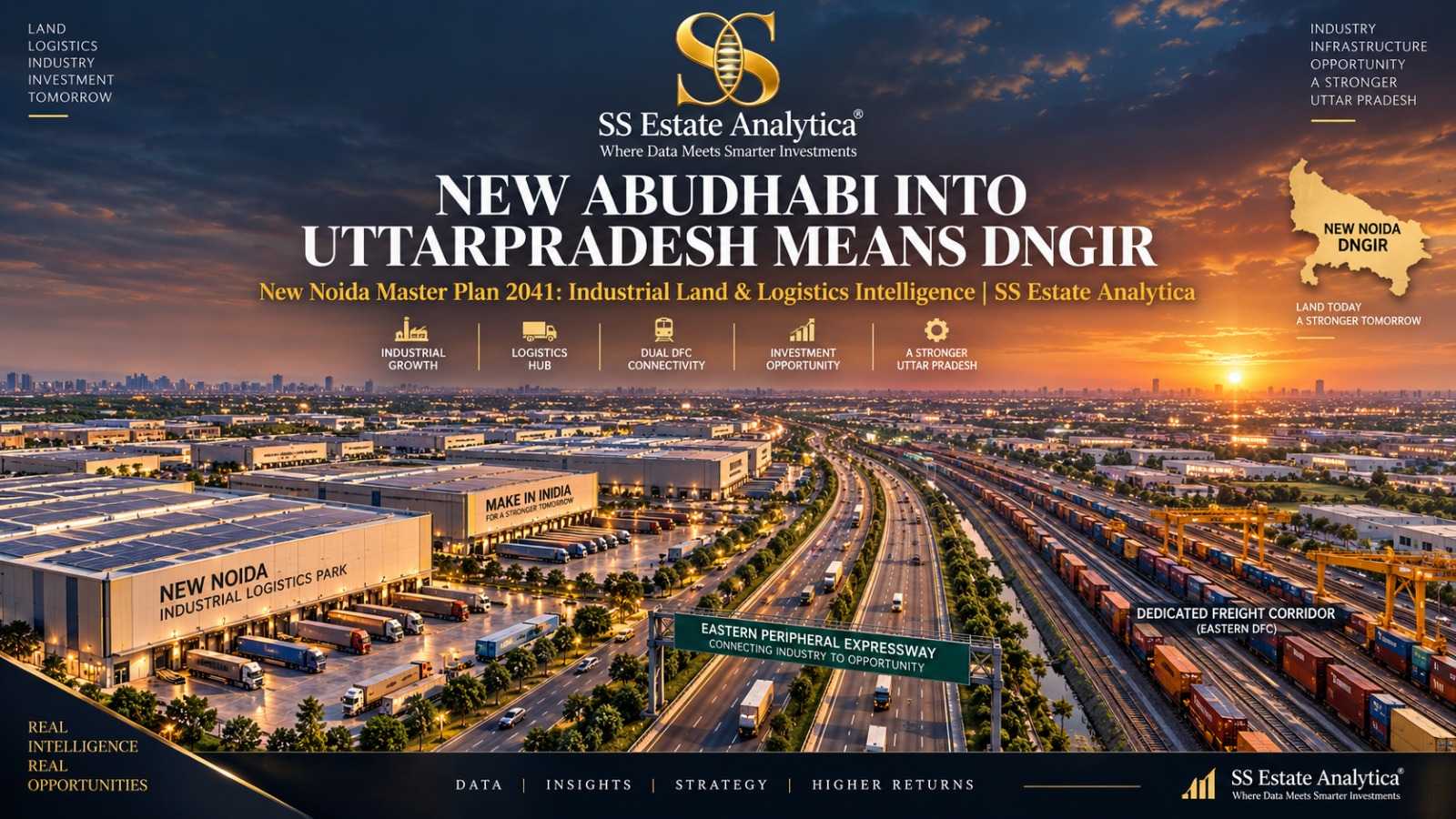
Dadri–Noida–Ghaziabad Investment Region (New Noida Master Plan 2041): An Explanatory Investment-Zone Report on Industrial Land, DMIC Logistics, Jewar Airport Catchment, and the 2030–2045 Execution Path
Executive Thesis: With Noida’s historic industrial land bank effectively saturated, the Government of Uttar Pradesh and Noida Authority have notified a 209.11 square kilometre greenfield economic city across 84 villages in Gautam Buddh Nagar and Bulandshahr. Officially designated as the Dadri–Noida–Ghaziabad Investment Region (DNGIR) and branded publicly as New Noida, this economic engine is built on an Abu Dhabi-style industrial model (KEZAD/KIZAD framework): industry-first urban design, logistics prioritized before housing, trunk infrastructure preceding plot allotment, and dedicated freight connectivity serving as an inland port. Below is SS Estate Analytica’s comprehensive 20-year execution roadmap and industrial land evaluation.
📊 DNGIR (NEW NOIDA) MASTER PLAN 2041 AT A GLANCE
- Notified Area: 209.11 sq km (20,911 hectares) spanning 84 revenue villages (63 Bulandshahr + 21 Gautam Buddh Nagar).
- Statutory Approval: Prepared under the UP Industrial Area Development Act, 1976; DNGIR Master Plan 2041 officially notified on 18 October 2024.
- Land-Use Constitution: 40% Industrial (8,421+ hectares) • 18% Green & Recreational • ~17% Transport & Utilities • Only 13% Residential • 8% Institutional • 4% Commercial.
- Multi-Modal Freight Moat: Anchored directly at the confluence of the Western Dedicated Freight Corridor (WDFC terminus at Dadri) and Eastern Dedicated Freight Corridor (EDFC), directly on the Eastern Peripheral Expressway (EPE), ~32 km from Noida International Airport at Jewar.
- Phase 1 Acquisition Target: 3,165 hectares across 37 villages by 2027 (field surveys active in 2026).
- Demographic Projections: Planned resident population of ~6 lakh by 2041; employment capacity of ~12 lakh jobs by around 2040 across the wider investment region.
🏛️ 1. HOW AND WHY DNGIR BECOMES THE “ABU DHABI OF UTTAR PRADESH”
The market phrase “New Abudhabi into Uttarpradesh means DNGIR” represents an intentional urban planning methodology, not sovereign concessions, tax-free regimes, or copied architectural skylines:
- The Planning Analogy (KEZAD / KIZAD Model): Abu Dhabi’s industrial-zone system functions because land is assembled at massive contiguous scale, heavy and light industries are segregated into dedicated clusters, roads and utilities are built prior to occupancy, and the entire zone is tied to a dedicated cargo exit. DNGIR replicates this methodology in inland North India by treating the Dadri dual-DFC freight terminal and Multi-Modal Logistics Hub (MMLH) as its “port equivalent”.
- The “Why Now” of DNGIR: Noida’s core industrial sectors are sold out, Greater Noida has limited contiguous large parcels remaining, and YEIDA is primarily oriented around the aerotropolis and expressway urbanism. DNGIR represents the final contiguous, Authority-assembled mega-industrial land bank in Uttar Pradesh capable of providing 10, 25, or 100-acre footprints to global manufacturers.
- Six Operating Conditions Required to Earn the Title:
- Consent-Based Land Acquisition: Systematically closing Phase 1 (3,165 ha) and advancing Phases 2–4 to preserve a unified 8,421-hectare industrial fabric rather than a broken patchwork of fields.
- Infra-Before-Allotment: Delivering trunk roads, power sub-stations, circular drainage, and water grids prior to rolling out commercial plot e-auctions.
- Policy Stability: Preserving a predictable, single-window industrial allotment code over multi-year cycles without frequent rule changes.
- Freight Rail Monetization: Operationalizing the Dadri MMLH, Boraki Multi-Modal Transit Hub (MMTH), and Chola rail logistics land to ensure freight moves on tracks, not congested regional highways.
- Industrial-Grade Utilities: Guaranteeing certified power quality and circular water recycling, without which semiconductor and advanced electronics manufacturing cannot operate.
- Honoring Farmer Entitlements: Ensuring developed residential plots (6%–7%) are demarcated and delivered on schedule so original landholders remain long-term economic partners.
🗺️ 2. GEOGRAPHIC & MULTI-MODAL LOGISTICS LOCATOR
DNGIR is positioned at the intersection where western freight networks, eastern industrial transit, and international aviation logistics converge:
- Distance to Core NCR Hubs: ~33 km from Noida • ~24 km from Ghaziabad • ~32 km from Noida International Airport (Jewar).
- Arterial Highway Links: Direct frontage on the Eastern Peripheral Expressway (EPE), NH-91 (GT Road), and the Bulandshahr–Jewar arterial corridor.
- Future Express Connectors: Proposed link-expressways tying EPE, the Yamuna Expressway, and the Ganga Expressway.
- Rail & Cargo Infrastructure: WDFC terminal at Dadri, EDFC interchange, Delhi–Howrah rail spine, and ~1,500 hectares of logistics land planned near Chola station.
- Existing Industrial Base: Incorporates ~1,370 hectares of operational brownfield clusters across Sikandrabad Industrial Areas I & II as an immediate seed ecosystem.
📐 3. MASTER PLAN 2041: SPATIAL ZONING & CLUSTER ARCHITECTURE
Master Plan 2041 organizes 8,421 hectares of industrial zoning across three distinct spatial belts:
- Northern Zone (Living & Light Industry): Predominantly residential, worker walk-ups, institutional campuses, and light non-polluting manufacturing (food processing, garments, small electronics assembly).
- Central Zone (Mixed Industry & EDFC Rail Spine): Positioned along the Eastern Dedicated Freight Corridor; focused on containerized freight, auto-ancillaries, precision engineering, and FMCG manufacturing.
- Southern Zone (Heavy Industry & Logistics Spine): Direct alignment with Chola rail logistics and Jewar airport corridors; reserved for 3PL mega-warehousing, solar module production, building materials, and heavy process plants.
- EPE Commercial-Industrial Corridor: High-visibility commercial-industrial frontage along the Eastern Peripheral Expressway, functioning as the primary corporate showroom and regional headquarters strip by 2035.
🏭 4. COMPETITIVE BENCHMARK: DNGIR VS. NCR & NATIONAL INDUSTRIAL HUBS
📍 DNGIR (New Noida)
Greenfield DMIC Industrial Region
Land Availability
8,421+ Hectares (New large plots)
Freight & Logistics Moat
Dual DFC (WDFC + EDFC) + EPE + Jewar Airport (~32 km)
Key Strategic Limitation:
Greenfield assembly; multi-year utility execution lag
📍 Noida Industrial
Mature IT, Electronics & Light Assembly
Land Availability
Effectively saturated (Single-digit vacancy)
Freight & Logistics Moat
Highway / Expressway reliant; no direct rail freight yards
Key Strategic Limitation:
Zero contiguous land for large-scale factories
📍 Greater Noida / Ecotech
Integrated Townships & IITGN Campus
Land Availability
Constrained; mid-teen vacancy rates
Freight & Logistics Moat
Road networks; integrated with Dadri periphery
Key Strategic Limitation:
Secondary plot sizes; higher real estate costs
📍 YEIDA (Jewar Corridor)
Aerotropolis, Medical Device & Film City
Land Availability
Massive notified boundary
Freight & Logistics Moat
Direct Jewar Airport frontage; Yamuna Expressway
Key Strategic Limitation:
Industrial take-up historically slower; high vacancy
📍 IMT Manesar / Bawal
Haryana Automobile & Component Heartland
Land Availability
High occupancy; mature ecosystem
Freight & Logistics Moat
WDFC access via Rewari / Manesar spine
Key Strategic Limitation:
Saturated core; higher acquisition and circle rates
📍 KEZAD (Abu Dhabi)
Global Benchmark Industrial Free Zone
Land Availability
Master-planned contiguous clusters
Freight & Logistics Moat
Integrated deepwater Khalifa Port + Etihad Rail
Key Strategic Limitation:
Oil-state sovereign capex; not directly replicable in India
The NCR-East Division of Labor:
Noida remains the corporate IT and brownfield electronics capital; Greater Noida serves as the established institutional township and hi-tech hub (IITGN); YEIDA commands the airport-city, hospitality, and specialized parks (Medical Devices/Film City); and DNGIR emerges as the heavy manufacturing, engineering, and rail-freight capital on the Dadri logistics hinge.
⏳ 5. PHASING TIMELINE & THE 2026 COMPENSATION RESET
Development Phases & Land Distribution
- Phase 1 (Target 2027): 3,165 hectares across 37 villages (24 Bulandshahr + 13 Gautam Buddh Nagar).
- Phase 2 (Target 2032): 3,798 hectares expanding the northern residential and southern logistics grids.
- Phase 3 (Target 2037): 5,908 hectares developing the commercial-industrial frontage along the EPE.
- Phase 4 (Target 2041): 8,230 hectares completing the southern industrial and residential zones.
September 2026 Compensation Structure
Compensation remains the critical operational determinant for long-term delivery. Following farmer feedback, rates were restructured in September 2026:
- Phase 1 & 2 Rates: Aligned with Greater Noida Authority rates (lifted to ₹6,415 per sq m) plus 6% developed residential plots.
- Phase 3 & 4 Rates: Aligned with YEIDA rates (lifted to ₹4,558 per sq m) plus 7% developed residential plots.
- The Developed Plot Partnership: Developed residential plots turn original farmers into permanent stakeholders and urban landholders within New Noida, preserving social stability and project momentum.
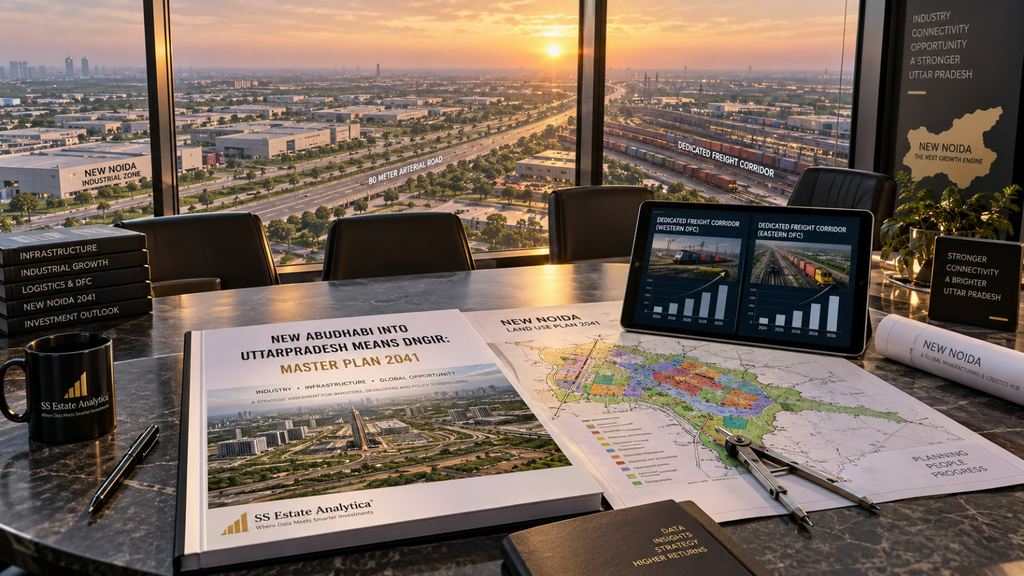
🚀 6. THE 20-YEAR ROADMAP (2030–2045 EXECUTION-SUCCESS SCENARIO)
- 2030 (The Beachhead Year):Phase 1 (3,165 ha) shifts from land surveys to an operational industrial zone. 60–80m sector road networks and primary power substations are readable from the EPE. First occupants launch operations in 3PL warehousing, auto-ancillaries, food processing, building products, and solar module assembly. Dadri MMLH commences initial commercial container operations. On-site population reaches 1.8–2.5 lakh.
- 2035 (The Production City):Cumulative developed footprint reaches ~7,000 hectares across Phases 1 & 2. The EPE commercial-industrial belt emerges as a recognizable corporate address. Dedicated ITI/polytechnic skill centers, industrial worker housing walk-ups, and circular water networks become functional. Resident population expands to 3.5–4.5 lakh, supported by regional mass-transit connectivity.
- 2040 (The Mature Investment Region):Master Plan 2041 design thresholds are realized. Phase 3 (EPE hub) is built out, and Phase 4 is underway. The high-density 4% commercial allocation functions as an active regional CBD. Dadri dual-DFC logistics is fully integrated, moving containers directly to western and eastern seaports without highway bottlenecks. Employment scales toward DMIC projections (~12 lakh regional capacity).
- 2045 (Compounding Industrial Metropolis):The 20,911-hectare territory operates as a mature manufacturing ecosystem. Raw land acquisition gives way to brownfield infills, shed modernizations, and vertical floor-area-ratio (FAR) enhancements under a successor “Master Plan 2061”. Phase-1 industrial plots trade actively in secondary markets at substantial premiums over initial allotment rates.
💼 7. ASSET CLASS EVALUATION FOR INVESTORS & OCCUPIERS
- 1. Industrial Plots & Manufacturing Parks (Highest Conviction — 2027–2032): Direct primary allotments through Noida Authority e-auctions. Focus on power availability and road width rather than speculative FAR numbers.
- 2. Grade-A Logistics & Warehousing (Immediate 2030 Demand): Prime asset class driven by Dadri DFC convergence and Jewar airport cargo spillover. Verify dedicated truck circulation and proximity to MMLH nodes.
- 3. Worker & Industrial Housing (Support Asset — 2029–2035): Essential for accommodating plant labor on-site. Underwrite purely on rental yield from workforce housing, not speculative luxury apartment absorption.
- 4. Farmer-Return Developed Plots (Selective Secondary Allocation): High liquidity post-infrastructure delivery. Demand thorough title searches, mutation verification, and authority transfer clearances before transacting.
- 5. Commercial & Retail (Long-Term Play — Post-2035): Commercial land comprises only 4% of the master plan. While scarcity is high, real demand will follow manufacturing density rather than precede it.
🏭
Connect with DNGIR Land Intelligence Desk
Access verified Master Plan 2041 village boundary maps, industrial allotment frameworks, and compensation tracking updates via WhatsApp.
Chat on WhatsApp (+91 97181 11251)
⚡ Instant Response • 🔒 100% Confidential • 📊 Industrial Land Intelligence
⚖️ STATUTORY & REGULATORY DISCLAIMER
This research dossier is prepared and published by SS Estate Analytica strictly for general educational and informational purposes as of 08 September 2026. It does not constitute an official government notification, scheme brochure, plot allotment offer, valuation certificate, or legal title opinion. All planning parameters, land-use percentages, village lists, and compensation figures are compiled from publicly accessible official notifications and news reports, which remain subject to revision by the Noida Authority, Government of Uttar Pradesh, or statutory courts. The 2030–2045 execution roadmaps represent hypothetical planning scenarios under stated assumptions and do not guarantee future commercial returns. Readers must carry out independent title searches, regulatory verification, and legal due diligence before entering into land transactions.
SS ESTATE ANALYTICA
Independent NCR Industrial, Logistics & Land Intelligence
📞 Phone: +91 97181 11251
🌐 Website: www.ssestateanalytica.com
📍 Focus Geography: DNGIR • New Noida • Dadri Freight Node • Jewar Aerotropolis • Delhi-NCR
