
Why the Next Wave of Hospitality, MICE, and Airport Demand Will Hunt Compact Keys — And Why Missing This Ticket Size May Cost More Than the Ticket Itself
Market Intelligence Brief | Date: September 2026 | Geography: Dwarka Expressway, Gurugram, Delhi-NCR | Horizon: Base Years 2029 • 2031 • 2035
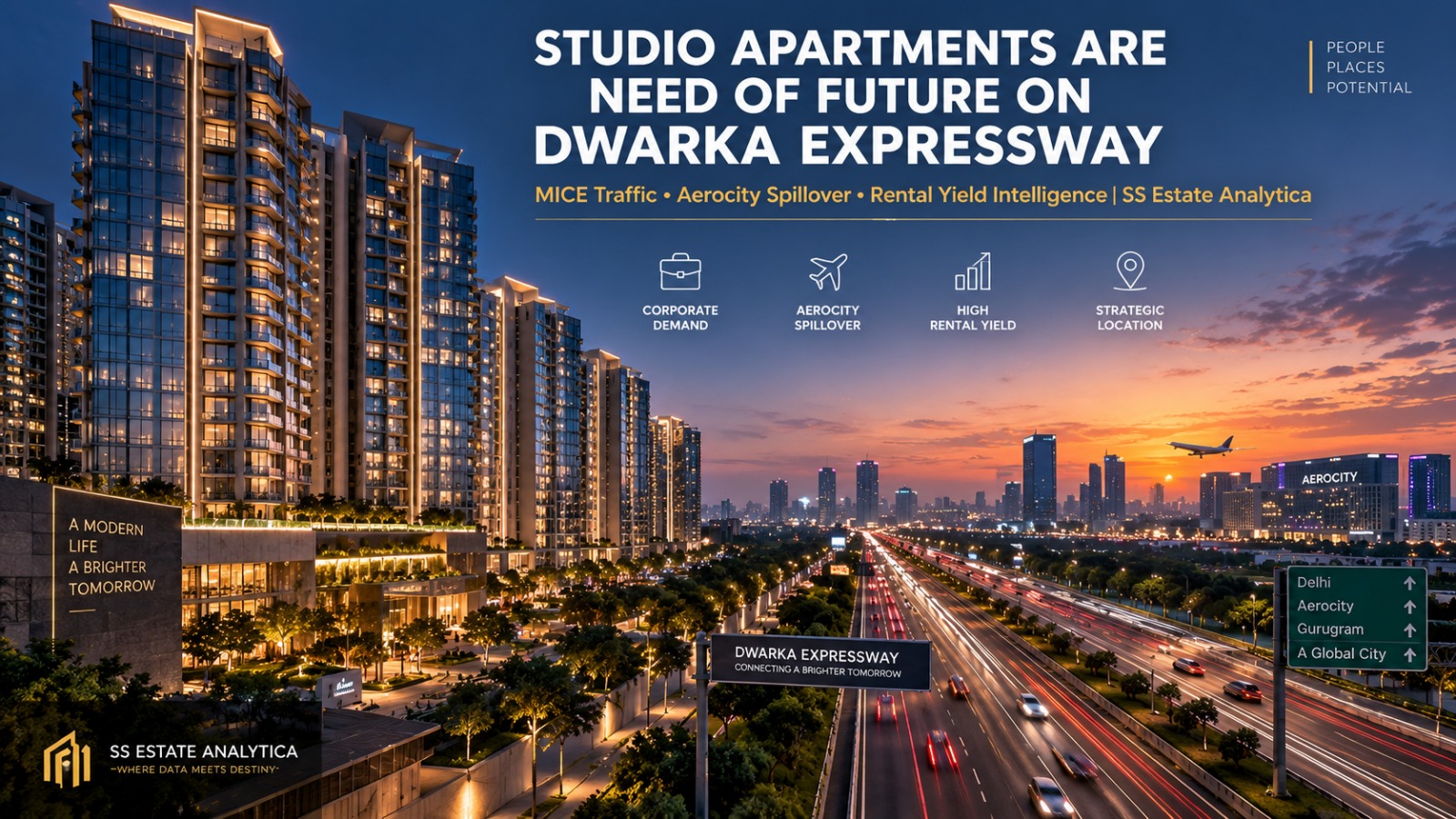
Executive Insight: The luxury 3 BHK and 4 BHK narrative on the Dwarka Expressway has matured, but the segment that remains critically under-owned is the compact key: the studio apartment, the 1 RK, and the lock-and-leave unit. As the western Delhi–Gurugram corridor transforms into an international hospitality and convention hub, three massive demand catalysts are converging simultaneously: Yashobhoomi MICE delegates, Aerocity and IGI Airport expansion, and marquee 5-star hotel clusters directly along the expressway. The strategic investment directive for this cycle: acquire the room that luxury hotels cannot build fast enough.
📊 DWARKA EXPRESSWAY STUDIO APARTMENTS AT A GLANCE
- Core Catalysts: Yashobhoomi (IICC) MICE overflow, Aerocity hospitality spillover, and 15–20 minute transit to IGI Airport Terminal 3.
- Entry Ticket Band: ₹45 Lakh to ₹1.10 Crore (Compared to ₹3.5–7.0 Cr+ for luxury 3/4 BHK family apartments).
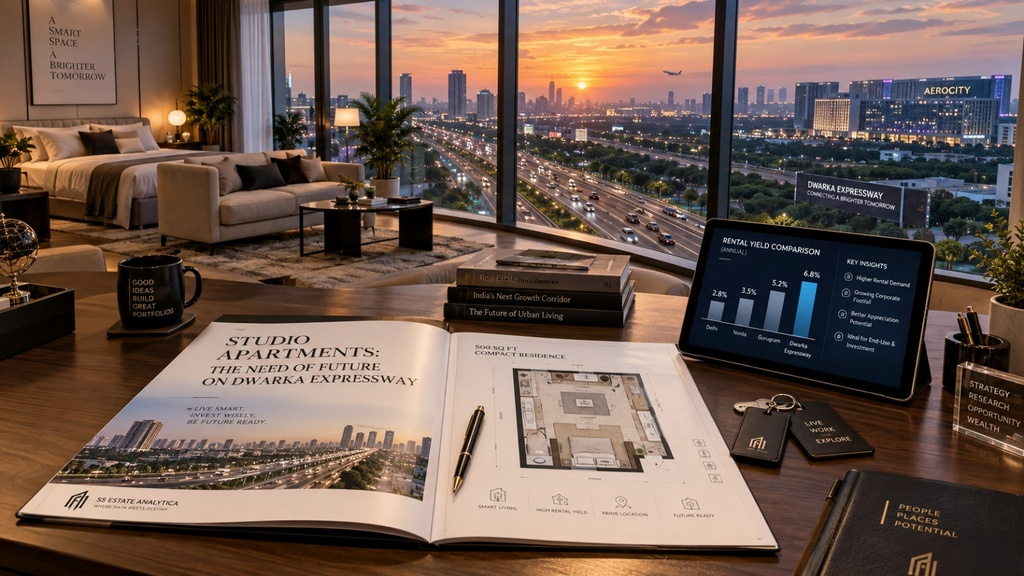
- Rental Yield Metrics: 3.0%–4.0% gross yield band in active, live sectors (versus 2.8%–3.4% on ultra-luxury large-format units).
- Occupational Demand Pool: Airline crews, management consultants, convention exhibitors, diplomatic staff, and corporate executives.
🏨 1. THE HOSPITALITY SHOCK WAVE IN MOTION (2026–2031)
Between 2026 and 2031, the Delhi–Gurugram border zone is being structurally rewired into a hospitality-driven urban ecosystem:
- Yashobhoomi (Dwarka Sector 25): ITC Hotels secured leasehold land in January 2026 on a 91-year lease (lease premium ~₹326.5 crore) for a premium 5-star hotel with banqueting at India’s largest convention center. Overflow delegates, exhibitors, and event operations crews continuously seek compact, walk-to-metro or short-drive units.
- Aerocity Hotel District: The addition of the New Delhi Marriott Marquis and St. Regis Aerocity (~779 combined rooms) creates India’s premier airport convention hub. As 5-star average daily rates (ADRs) climb, extended-stay business travelers divert to Dwarka Expressway studios offering equivalent transit convenience at lower price points.
- Dwarka Sector 23: Juniper Hotels is advancing a Grand Hyatt on DDA-allotted land near the golf course and diplomatic enclave with operations targeted around 2030, generating a multi-year executive rental base.
- Sector 106 (Dwarka Expressway): Elan Group and Marriott announced a JW Marriott Hotel alongside JW Marriott Residences within a ~50-acre mixed-use development, establishing an ultra-luxury brand halo across surrounding compact inventory.
🎯 2. SIX STRATEGIC FILTERS DRIVING THE COMPACT KEY THESIS
- 1. Portfolio-Friendly Capital Allocation: A ₹3.5–7.0 crore 3 BHK represents a major family balance-sheet commitment. An entry ticket of ₹45 lakh to ₹1.10 crore allows HNIs to accumulate multi-key clusters and gives NRIs an unleveraged foothold in NCR.
- 2. Pre-Existing Tenant Pipelines: Corporate travel, airport rotations, and convention calendars mean tenants are actively imported, with furnished monthly rentals already printing in the mid-teens to high-twenties thousand range.
- 3. Accessible Capital Appreciation Runway: While corridor-wide residential averages surged from ~₹6,000/sq ft in 2021 to the mid-₹14,000s by H1 2026 (and ₹18,000–24,000+ in luxury pockets), compact inventory still clears at an accessible all-in cheque.
- 4. Dual-Engine Return Model: Well-maintained studios generate 3.0%–4.0% gross rental yields that cover underlying asset holding costs while capital values compound.
- 5. Superior Resale Liquidity: Reselling a ₹6 crore luxury apartment depends on a narrow pool of high-net-worth buyers. A ₹70–80 lakh furnished studio appeals to end-users, startup professionals, airline staff, and retail investors.
- 6. Structural Supply Scarcity: While developers have launched thousands of 3 and 4 BHK units, legitimate, legally sanctioned residential studio/1 RK units with RERA registration and professional leasing bylaws remain scarce.
📈 3. RENTAL YIELD DRIVERS & GROSS-TO-NET RECONCILIATION
Ten Core Yield Determinants
- MICE Demand Surges: Yashobhoomi events create 7-to-21-day short-stay demand spikes.
- Airport Transit Radius: A strict 15–25 minute commute to IGI Airport commands premium tenant retention.
- Luxury Hotel ADR Spreads: Rising room rates at JW Marriott, ITC, and St. Regis establish an attractive pricing umbrella for serviced studios.
- Ticket-Size Math: A ₹70–80 lakh studio at ₹22,000–28,000/month achieves higher gross yield metrics than a ₹5 crore apartment at ₹65,000/month.
- Turnkey Furnishing: Hotel-grade fit-outs (kitchenette, workstation, high-speed Wi-Fi) command a ₹4,000–8,000 monthly rental premium over bare units.
- Corporate Tenant Quality: Low-default profiles including airline crew, corporate consultants, and tech personnel.
- Vacancy Discipline: Established sectors achieving 22–30 day turnaround windows preserve annualized returns.
- CAM & Operating Drag: Society maintenance and sinking funds must be budgeted carefully to protect net yield.
- Micro-Market Upgrades: Infrastructure milestones (such as metro spurs and retail hubs) drive organic rent escalation without landlord capital expenditure.
- Supply-Demand Mismatch: Limited supply of compact formats insulates owners against aggressive price-cutting.
Illustrative Gross-to-Net Bridge (Modelled on ₹24,000 Monthly Rent / ₹80 Lakh Ticket)
- Gross Asking Rent: ₹24,000 per month (₹2.88 Lakh/year = 3.60% Gross Yield)
- Less Vacancy Reserve (Modelled at ~6 Weeks): ~₹2,770 per month
- Less Society CAM & Sinking Fund: ₹3,500 – ₹5,000 per month
- Less Professional Management Fee (Optional 8–12%): ₹1,900 – ₹2,900 per month
- Estimated Net In-Hand Income: ~₹16,000 – ₹18,000 per month (~2.4% – 2.7% Net Yield before taxation and interior depreciation)
📊 4. VALUE MATRICES & WEALTH STACK MODELS (2026–2035)
Prime Model Unit (500 sq ft @ ₹16,000/sq ft = ₹80 Lakh Base Ticket)
- Conservative Scenario (6% CAGR): ₹95.3 Lakh (2029) • ₹1.07 Crore (2031) • ₹1.35 Crore (2035)
- Base-Case Scenario (8% CAGR): ₹1.01 Crore (2029) • ₹1.18 Crore (2031) • ₹1.60 Crore (2035)
- Bull-Case Scenario (10% CAGR): ₹1.06 Crore (2029) • ₹1.29 Crore (2031) • ₹1.89 Crore (2035)
Base-Case Combined Wealth Stack (8% Asset Appreciation + 5% Annual Rent Growth)
- By Year-End 2029 (3 Years): Asset Value: ₹1.01 Cr | Cumulative Gross Rent: ~₹9.1 L | Total Stack: ~₹1.10 Cr (+37%)
- By Year-End 2031 (5 Years): Asset Value: ₹1.18 Cr | Cumulative Gross Rent: ~₹15.9 L | Total Stack: ~₹1.33 Cr (+67%)
- By Year-End 2035 (9 Years): Asset Value: ₹1.60 Cr | Cumulative Gross Rent: ~₹31.8 L | Total Stack: ~₹1.92 Cr (+140%)
Entry-Level Model Unit (400 sq ft @ ₹12,000/sq ft = ₹48 Lakh Base Ticket)
- 8% Base-Case Appreciation: ₹60.5 Lakh (2029) • ₹70.5 Lakh (2031) • ₹96.0 Lakh (2035)
⚠️ 5. THE COST OF SIDELINING THE COMPACT SEGMENT
Failing to evaluate the studio segment on Dwarka Expressway is not merely missing a promotional launch; it means missing a structural demographic shift:
- Luxury hotel ADRs in Aerocity and Dwarka continue to rise without benefiting your balance sheet.
- Institutional operators and seasoned NRIs absorb available compact inventory, removing high-yield assets from the secondary market.
- As launch prices move upward, entry-level conversations shift from ₹48–80 lakh toward ₹75 lakh–1.3 crore.
- Traveling executives continue paying retail hotel and serviced-stay rates rather than building personal corridor equity.
🔍 6. MANDATORY INVESTOR DUE DILIGENCE CHECKLIST
- Statutory Residential Sanction: Verify Haryana RERA registration to confirm the property is a legally approved residential apartment, not an illegal commercial conversion or unauthorized flat partition.
- Society Bylaws & Tenancy Terms: Ensure association rules permit leases for single corporate professionals, bachelors, and serviced short-stay arrangements.
- Realistic Net Operating Models: Deduct maintenance costs, property tax, a 6–8 week vacancy buffer, and furnishing maintenance reserves from gross yield estimates.
- Track Record of Delivery: Prioritize developers with proven execution history on the Dwarka Expressway to eliminate long-term completion risks.
- True All-In Cost Underwriting: Factor in statutory GST, stamp duty, registration, and complete interior fit-out capex (adding 8%–15% to the base purchase price).
💬
Connect with SS Estate Analytica
Get instant access to verified project shortlists, net rental yield calculators, and developer compliance audits via WhatsApp.
Chat on WhatsApp (+91 97181 11251)
⚡ Instant Delivery • 🔒 100% Confidential • 📊 Institutional Intelligence
⚖️ STATUTORY & REGULATORY DISCLAIMER
This document is an independent market commentary and research brief prepared by SS Estate Analytica solely for educational, informational, and discussion purposes as of September 2026. It does not constitute a prospectus, an offer document, financial or investment advice, or a solicitation to buy real estate assets. All cash flow projections, yields, appreciation rates, and 2029–2035 modelled values represent mathematical scenarios based on stated assumptions and should not be construed as performance guarantees. Investors must perform independent title, RERA registration, and legal due diligence before making capital commitments.
SS ESTATE ANALYTICA
Independent PropTech Advisory | NCR Real Estate Intelligence
📞 Phone: +91 97181 11251
🌐 Website: www.ssestateanalytica.com
📍 Focus Geography: Dwarka Expressway • Yashobhoomi Orbit • Gurugram • Delhi-NCR