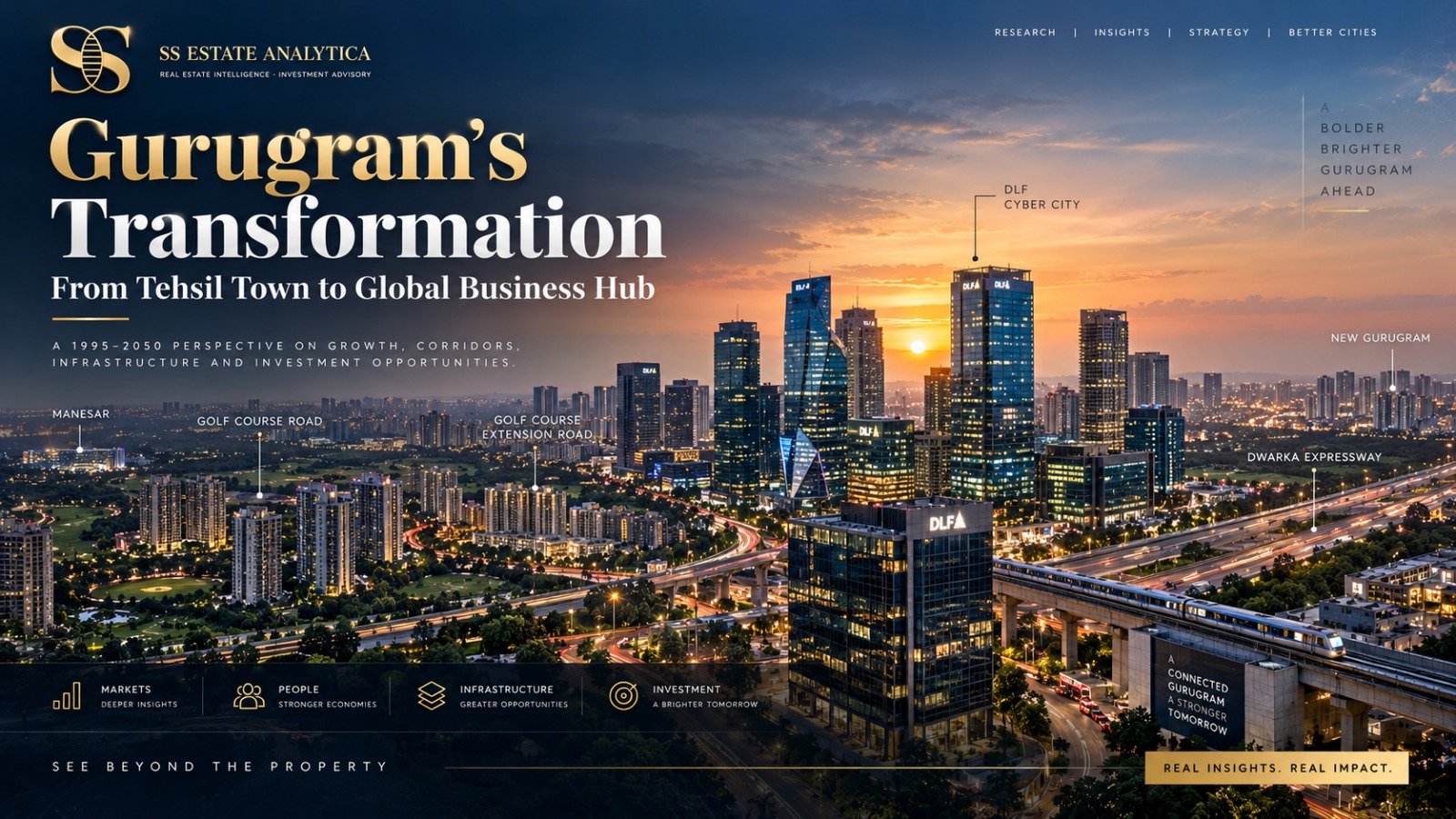
By SS Estate Analytica | Real Estate Intelligence & Investment Advisory
Gurugram is no longer simply a satellite city of Delhi.
Over the last three decades, it has transformed from a semi-rural tehsil landscape into one of North India’s most important corporate, residential and commercial real-estate markets. But the next phase of Gurugram may be even more significant.
The real question is no longer whether Gurugram will grow.
The question is:
What kind of city will Gurugram become by 2031, 2041 and 2050 — and what will that transformation mean for real-estate capital?
SS Estate Analytica’s latest research visualises Gurugram’s evolution from 1995 to 2050 through four lenses: history, infrastructure, growth corridors and risk.
From Mustard Fields to Cyber City
In the early 1990s, Gurugram looked dramatically different.
The landscape around the Mehrauli–Gurgaon Road was dominated by agricultural land, small settlements and a limited number of established colonies. The district’s 1991 population was approximately 1.1 million.
But the foundations of today’s city had already been laid.
The Maruti plant established in 1981, Haryana’s urban-development framework and private township development created the conditions for agricultural land to gradually acquire urban value. DLF’s early developments and the emergence of Cyber City subsequently demonstrated a powerful model:
premium housing + Grade-A commercial space + proximity to Delhi + private infrastructure.
Then came India’s 1991 economic reforms.
Global businesses needed office space, connectivity and access to talent. In 1997, GE’s captive operation — later associated with Genpact — helped establish the BPO/ITES ecosystem that would eventually become one of Gurugram’s strongest economic engines.
The city’s growth was therefore not driven by residential speculation alone.
Jobs created the demand.
The Second Transformation: 2010–2026
The next phase changed Gurugram’s physical identity.
Metro connectivity, Rapid Metro, NH-8/NH-48 improvements and large-scale group housing development transformed the highway city into a high-rise urban market.
By 2025–26, working estimates cited in the report place the urban complex at roughly 25–30 lakh people, while Gurugram’s Grade-A office market had crossed the 100 million sq. ft. threshold in industry reporting.
This matters because office stock is more than a real-estate statistic.
It represents:
- Corporate employment
- GCC expansion
- Rental demand
- Housing demand
- Retail consumption
- Hospitality demand
- Transportation requirements
In other words:
Gurugram’s real-estate story is fundamentally an employment story.
Gurugram Is No Longer One Market
One of the most important changes for investors is the emergence of multiple growth corridors.
Instead of looking at “Gurugram” as one market, capital increasingly needs to understand individual micro-markets.
1. Golf Course Road
A mature premium corridor with established residential and commercial infrastructure.
The market is characterised by scarcity, high-value residential inventory and established corporate demand.
2. Golf Course Extension Road
A major luxury-residential expansion belt with growing social infrastructure and a longer development runway.
3. Southern Peripheral Road — SPR
SPR represents the transition between established Gurugram and the next generation of commercial and residential development.
4. New Gurugram
A large township-scale expansion zone where social infrastructure, employment centres and residential development are still evolving.
5. Dwarka Expressway
Perhaps the most visible connectivity-led transformation story.
The corridor connects Gurugram more directly with Delhi, IGI Airport and the wider NCR ecosystem, changing the accessibility equation for sectors along the expressway.
Infrastructure Is the Real Repricing Engine
For Gurugram, infrastructure isn’t simply about reducing travel time.
It can change the economic geography of land.
A road can turn a peripheral sector into a connected residential market.
A metro station can turn a location into a transit-oriented development zone.
A regional rail connection can expand the labour market far beyond city boundaries.
The report identifies several infrastructure layers that could influence Gurugram’s next cycle:
- Dwarka Expressway
- Gurugram Metro expansion
- Delhi–Gurugram–Alwar RRTS
- Gurugram–Greater Noida RRTS concept
- KMP Expressway
- Delhi–Mumbai Expressway
- Sohna elevated corridor
- IICC / Aerocity ecosystem
- Global City
- IMT Manesar and industrial corridors
But there is an important distinction:
A planned infrastructure project is not the same as an operational infrastructure asset.
For investment analysis, commissioned or contractually committed infrastructure deserves more weight than infrastructure that exists only on a planning map.
What Happens to Gurugram by 2031?
The report treats 2031 differently from longer-term scenarios because the GMUC 2031 framework already provides a notified planning reference.
Under the plan, the Gurugram–Manesar urban complex has a population target of approximately 42.5 lakh, with expansion across a much larger urbanisable area.
By this stage, the expectation is not simply more towers.
The more important transformation could be from a highway-led city to a polycentric city.
That means multiple employment and residential centres connected through roads, metro and regional transport.
Cyber City would no longer be the only major economic anchor.
SPR, Golf Course Extension, Dwarka Expressway, Global City and Manesar could increasingly function as interconnected urban nodes.
Gurugram 2041: The Regional City
The 2041 picture is less certain.
The report uses the NCR Draft Regional Plan 2041 as a framework for imagining a more integrated NCR, with Gurugram potentially functioning as part of a 30-minute regional connectivity ecosystem.
RRTS, multimodal hubs and KMP connectivity could potentially bring Manesar, Panchgaon and southern Gurugram into a wider labour market connecting Delhi, Faridabad and parts of Rajasthan.
A working population number of around 55 lakh is discussed in the report, but importantly, this is treated as a planning/working scenario rather than a guaranteed outcome.
This distinction matters.
A scenario is not a forecast.
And a forecast is not a guarantee.
Gurugram 2050: Two Possible Futures
Perhaps the most interesting part of the report is its approach to 2050.
Instead of presenting one glossy vision of the future, SS Estate Analytica presents two possible scenarios.
Scenario 1 — Managed Metropolis
In this scenario:
- GCC and services remain strong
- Multiple CBDs mature
- Transit-oriented development expands
- Institutional ownership increases
- Rental housing becomes deeper
- Green and climate infrastructure improves
- Well-governed, transit-connected assets retain stronger relevance
Scenario 2 — Stressed Prize
In the second scenario:
- Population continues increasing
- Mobility constraints remain
- Flooding and drainage become larger economic issues
- Development becomes more fragmented
- Quality differences between micro-markets become extreme
- Assets dependent purely on future civic improvement face greater uncertainty
The key message is powerful:
The future of Gurugram isn’t determined only by how many people live there. It depends on whether infrastructure, mobility, water, drainage and governance can keep pace with population and economic growth.
The Risks Investors Cannot Ignore
A sophisticated real-estate analysis cannot focus only on appreciation.
Gurugram’s growth story comes with structural risks.
Drainage & Flooding
Waterlogging and blocked natural channels can disrupt commercial corridors and affect asset usability.
Water Security
Groundwater stress and tanker dependence can become increasingly important in rapidly urbanising areas.
Mobility
High car dependency and gaps in public transport can influence both liveability and productivity.
Oversupply
Large luxury launches can create pressure on absorption, particularly when investor demand becomes stronger than end-user demand.
Developer & Title Risk
Land history, licences, RERA records, litigation and promoter execution remain critical.
Climate & Aravalli Risk
Environmental restrictions, heat, air quality and Aravalli-related regulatory issues can influence future development.
Liquidity
Not every location with a high quoted price has an equally deep resale market.
These risks are explicitly included in the report’s risk register rather than treated as an appendix.
So, What Should Investors Actually Watch?
The answer isn’t simply “buy Gurugram.”
The more useful framework is to ask five questions:
01. Where is the employment coming from?
Real estate ultimately needs economic demand.
02. Which infrastructure is already operational?
Separate today’s connectivity from tomorrow’s promise.
03. Is the micro-market end-user driven?
End-user depth can matter significantly for rental stability and resale liquidity.
04. What is the developer’s delivery history?
A beautiful brochure cannot replace execution history.
05. Can the asset survive the downside scenario?
The report’s central investment discipline is essentially this:
Position for upside, but make sure the investment can survive the stressed scenario.
The SS Estate Analytica Approach
SS Estate Analytica describes its role as a research-led real-estate intelligence and investment-advisory practice, rather than a developer sales desk.
Its stated research framework combines:
Market Research → Investment Analysis → Developer Due Diligence → Location Intelligence → Risk Scoring → Mandate Advisory.
That means the objective isn’t simply to identify the next “hot sector.”
It is to understand why a location may work, what could invalidate the thesis, and which risks need to be priced before capital is committed.
Final Thought
Gurugram’s first transformation was physical.
Fields became sectors.
The second transformation was economic.
Local industry became a global services and GCC ecosystem.
The next transformation will be institutional.
Roads, metro, RRTS, water, drainage, governance and climate resilience will determine whether Gurugram evolves into a genuinely mature metropolitan ecosystem.
For investors, the opportunity is therefore not simply to identify where the next tower will rise.
It is to understand where infrastructure, employment, scarcity, governance and end-user demand intersect.
Because in the next cycle of Gurugram real estate:
The winning address may not simply be the one with the tallest skyline — but the one with the strongest underlying urban system.
SS Estate Analytica
Where Data Meets Real Estate Destiny
Real Estate Intelligence · Investment Advisory