
Independent Underwriting Brief on Office Physics, Corridor Bifurcation, Infrastructure Shocks, and Horizon Scenarios for Institutional Capital
Core Research Perspective
Global capital arriving in North India encounters Gurugram as a finished, vertical skyline: institutional-grade glass campuses, an operational urban expressway, and a cluster of multinational headquarters that mirrors prime commercial nodes across Dubai or East Asia. However, viewing Gurugram merely as a completed metropolis obscures its underlying operational reality.
The city represents a thirty-year case study in private-sector urbanisation on the Delhi fringe—unprecedented in capital formation, but structurally uneven in public civic delivery. Gurugram remains mid-cycle on the decisive trunk mobility and environmental infrastructure that will dictate risk-adjusted returns through 2050.
Key Macro Indicators: The Gurugram Urban Complex
- Organised Employment Share: Over 60% of Haryana’s total formal, organised-sector workforce is concentrated in Gurugram, up from the high teens in the mid-2000s.
- Commercial Absorption Threshold: Crossed 100 million square feet of Grade-A office stock in 2025–26, with institutional projections targeting 120–125 million sq. ft. by 2030.
- Population Horizon: Expanded from 11 lakh in Census 1991 to ~30 lakh in 2025–26, with an operative master-plan target of 42.5 lakh by 2031 and planning estimates exceeding 55 lakh for 2041.
- Asset-Class Scale: Approximately 59 million sq. ft. of operational office inventory is green-certified, with international occupiers leasing an estimated 17 million sq. ft. across five recent operating cycles.
1. 1995–2010: The Genesis of the Private-Led City
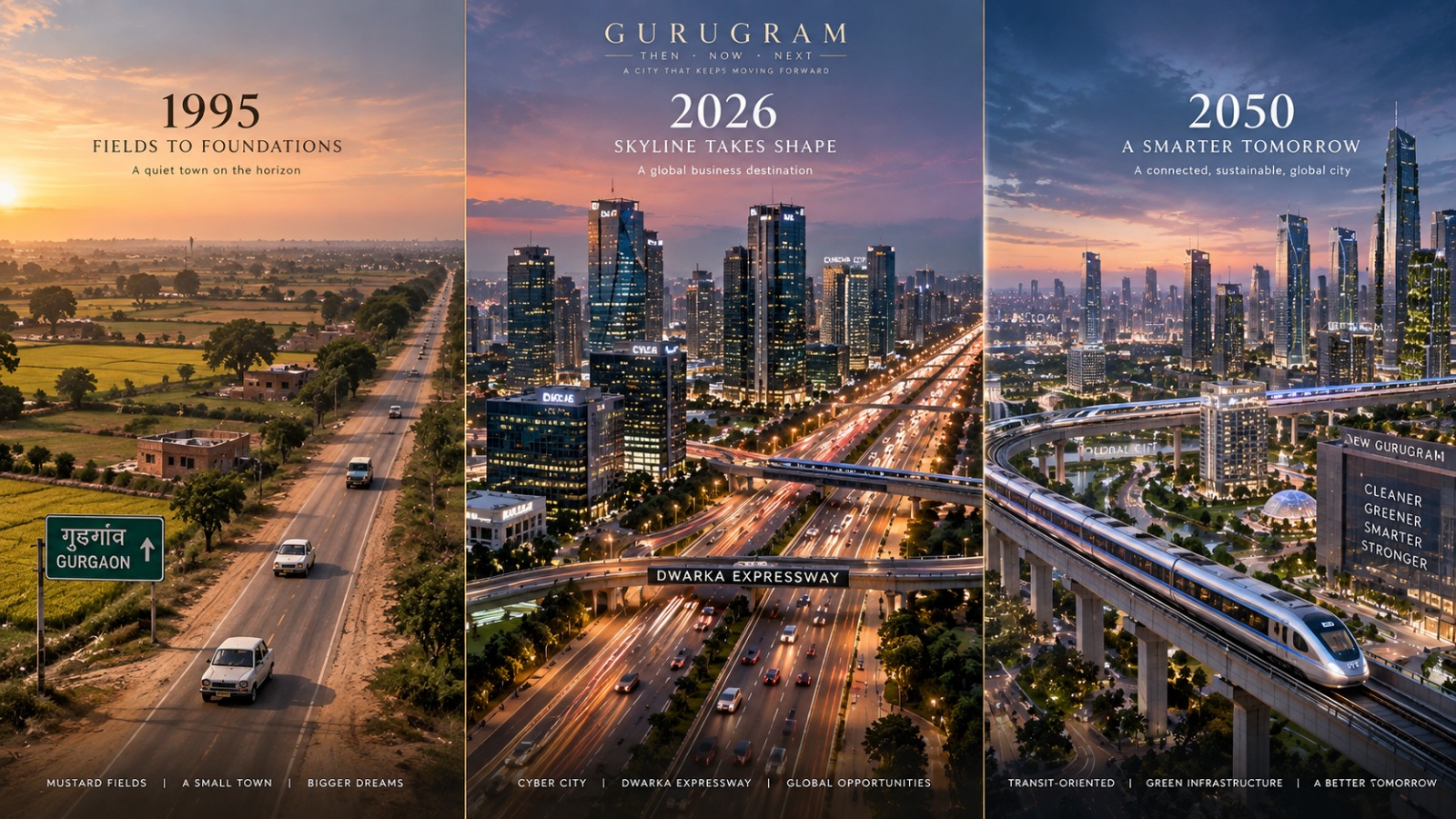
Prior to economic liberalisation, the Mehrauli-Gurgaon corridor was defined by agricultural fields, unpaved tracks, and a quiet tehsil economy. Urbanisation was catalysed by two legal frameworks and an anchor industrial manufacturing facility:
- The Statutory Opening: The Haryana Development and Regulation of Urban Areas Act (1975) and the HUDA Act (1977) permitted private developers to assemble, license, and develop large-scale agricultural tracts, providing private capital an entry point rarely seen in other Indian states.
- The Industrial Anchor: Maruti Udyog’s 1981 manufacturing plant in the Gurugram-Manesar belt established the initial supplier ecosystem, freight networks, and industrial connectivity.
- Corporate Inception: Following national economic reforms in 1991, DLF’s integrated campus execution (Garden Estate, followed by Hafeez Contractor’s walk-to-work master layout for DLF Cyber City) created a blueprint for modern Indian office developments.
- The ITES/BPO Shift: In 1997, GE established its captive operational back-office (later Genpact), transforming Gurugram from an auto-manufacturing hub into North India’s central export hub for business process outsourcing and enterprise IT.
The defining anomaly of this growth phase was civic sequencing: the private skyline, commercial campuses, and luxury residential enclaves were fully active years before the formal creation of the Municipal Corporation of Gurgaon (MCG) in 2008.
2. 2010–2026: Scale, GCC Dominance, and the Four-Corridor Split
By the mid-2020s, treating “Gurugram” as a single homogenous real estate market became obsolete for institutional underwriting. Capital allocations bifurcated across four distinct development corridors governed by the Gurgaon-Manesar Urban Complex (GMUC) Final Development Plan 2031 (spanning 115 sectors across ~33,872 hectares):
| Corridor & Focus Sectors | Prevailing Character (2025–26) | Indicative Price Range (₹ / sq. ft.) | Primary Capital Profile |
|---|---|---|---|
| Golf Course Road (Core) (Sectors 42–43, 53–56) | Mature trophy luxury high-rises; sub-5% office vacancy; institutional REIT dominance; absolute physical land scarcity. | ₹18,000 – ₹28,000+ (Trophy outliers cross ₹40,000+) | Ultra-HNIs, corporate CXOs, institutional REITs, long-hold capital. |
| Golf Course Extension (Sectors 58–67) | Emerging ultra-luxury enclave; rapid social infrastructure density; high-ticket residential absorption. | ₹14,000 – ₹20,000 | Domestic HNIs, family offices, upgrade capital. |
| Dwarka Expressway (Sectors 99–115, 36B/37) | Operational 16-lane urban expressway; rapid travel-time compression to IGI Airport & Delhi; violent circle-rate repricing. | ₹11,000 – ₹16,000 | Cross-border NRIs, portfolio investors, institutional developers. |
| SPR & New Gurugram (Sectors 68–95) | Large-scale integrated townships; emerging “Cyber City 2.0” commercial zones; evolving transit links. | ₹9,000 – ₹14,000 | First-time luxury buyers, long-horizon growth capital, upgraders. |
*Price bands reflect indicative mid-cycle averages per sq. ft. across prevailing corridor samples. Project-level specifications vary.
3. The Infrastructure Stack: Physical Triggers That Reprice Land
In Gurugram’s real estate physics, investment returns are tied directly to transit velocity, airport access, and public infrastructure completions:
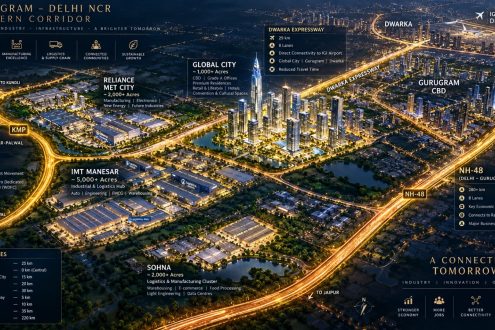
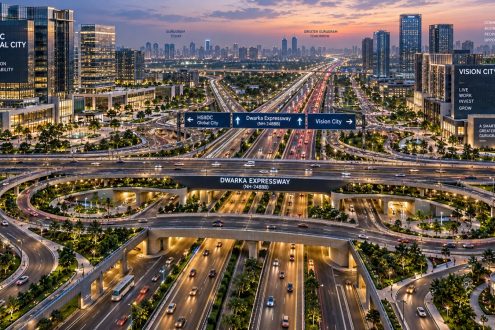
- Dwarka Expressway (NH-248BB): A fully operational elevated corridor and tunnel network to Delhi’s Terminal 3 that unblocks northern and western sectors.
- New Gurugram Metro Ring: A 28.5 km, 27-station mass-transit loop awarded in late 2025 designed to connect HUDA City Centre across Cyber City, Subhash Chowk, Sector 101, and the railway interchange.
- Delhi–Alwar RRTS (Namo Bharat): A semi-high-speed commuter rail alignment designed to connect Delhi, Cyber City, Kherki Daula, and Manesar within a 30-minute regional travel shed.
- Southern & Regional Connectors: The operational Delhi–Mumbai Expressway (DME) via the Sohna elevated highway, alongside the Western Peripheral / KMP Expressway serving as the outer industrial ring.
- Global City Anchor (Sectors 36B/37B): A planned ~1,000-acre mixed-use development positioned as Haryana’s future central business district.
Underwriting Principle:
Price committed, contracted, and operational infrastructure far heavier than
"in-principle" master-plan proposals. In NCR, the gap between a planning map
and a functioning transit line has historically spanned 5 to 10 years.
4. Visualising the 2031, 2041, and 2050 Horizons
Rather than relying on speculative long-range forecasts, institutional allocators must evaluate three distinct planning scenarios grounded in statutory records:
Horizon A — 2031: The Notified Master-Plan City
- The Blueprint: Anchored by the legally notified GMUC Final Development Plan 2031.
- Key Targets: 42.5 lakh population across 339 sq. km of urbanisable land; Grade-A office stock reaching the 120–125 million sq. ft. band.
- Physical Profile: Sectors 58 through 115 transition from developing sectors into fully occupied neighbourhoods. Dwarka Expressway functions as an established commuter corridor, and the Southern Peripheral Road operates as an active second commercial spine.
Horizon B — 2041: The Polycentric Regional Node
- The Blueprint: Aligned with the Draft Regional Plan 2041 (NCRPB) and ongoing GMDA Master Plan 2041 preparations.
- Key Targets: Projected population range of 55 lakh+.
- Physical Profile: Transition to transit-oriented development (TOD) featuring higher FAR allowances within 500 metres of operational RRTS and metro stations. Gurugram operates as an integrated hub within a 30-minute NCR commuter radius connecting Delhi, Manesar, and Faridabad.
Horizon C — 2050: Two Competing Scenarios
Because no formal statutory master plan exists for 2050, capital committees must weigh two realistic scenarios:
- Scenario S1 (The Managed Metropolis): Mass rapid transit, stormwater flood retention networks, and sewage-treatment facilities keep pace with an urban complex of 65–70 lakh residents. Institutional REIT and pension ownership deepens across commercial and multi-family residential assets, while rigorous ESG rules preserve the Aravalli catchment.
- Scenario S2 (The Stressed Prize): Commercial headcount and office leasing continue to surge, but municipal drainage, bus transit, and water-recycling execution lag behind private construction. Severe monsoon waterlogging and utility strains widen the risk premium, causing steep valuation discounts for unintegrated, car-dependent edge plots while trophy, self-contained townships capture historic premiums.
5. Institutional Risk Register & Underwriting Filters
- Drainage and Hydrology Deficit: Intense monsoon downpours periodically overwhelm natural stormwater drainage, causing waterlogging along key commercial arteries. Allocators must inspect micro-contour maps and verify as-built drainage easements to prevent portfolio downtime.
- Water Security Constraints: Ongoing groundwater depletion requires reliance on surface canals and municipal supply. Developments lacking operational on-site sewage treatment plants (STPs), dual-plumbing circuits, and verified municipal connections carry operational hazards.
- Supply-Wave Congestion (2026–2028): Significant luxury residential inventory slated for delivery through FY27 requires scrutiny of end-user absorption depth versus speculative investor holding capacity.
- Regulatory Compliance & Title Chains: Diligence must extend beyond glossy brochures into statutory Haryana RERA (HARERA) filings, developer balance-sheet liquidity, external development charges (EDC/IDC) clearance certificates, and approved building plans.
6. Summary: Allocating Capital Across the Gurugram Arc
Gurugram demonstrates the immense power of private enterprise to build a corporate skyline, while highlighting the structural costs that emerge when private real estate outpaces municipal systems.
For global institutions, venture offices, and high-net-worth individuals, generating resilient returns requires avoiding generic regional bets. Portfolios must focus strictly on the intersection of verified corporate demand, developers with multi-cycle completion track records, and committed public infrastructure already visible on the ground.
Connect Directly with the SS Estate Analytica Research Desk
Access institutional corridor dossiers, infrastructure commissioning trackers, and independent buy-side due diligence files:
- Direct Desk Consultation: Chat on WhatsApp (+91 97181 11251)
- Corporate Portal: www.ssestateanalytica.com
- Central Research Desk: WorldMark Asset, Hospitality District, Aerocity, New Delhi
- Regional Serviced Desks: Lucknow • Mumbai (WeWork NESCO) • Bengaluru (WeWork Manyata)
Statutory & Research Disclaimer: This document is compiled by SS Estate Analytica solely for educational, analytical, and visualization purposes as of September 2026. It does not constitute a statutory prospectus, a formal investment advisory mandate under SEBI regulations, or a solicitation to buy or sell securities or real estate assets. Figures marked as future scenarios reflect planning estimates and are subject to market, regulatory, and contractor variations. Institutional investors must conduct independent legal, financial, and technical due diligence before allocating capital.

SS Estate Analytica
Your Trusted Place to Find a Home At SS Estate Analytica, we are redefining real estate through the power of intelligence, innovation, and integrity. Born in Gurgaon and built for India’s ambitious future, we combine deep market analytics with practical expertise to help individuals, families, and investors Buy • Build • Manage • Invest with complete confidence. With 8,000+ new listings added daily and over 68,000 verified properties, we deliver transparency, accuracy, and speed in every transaction. Powered by data-driven insights and a strong commitment to sustainability, we go beyond listings — we provide the smart intelligence you need to make informed, future-ready real estate decisions. PAN India reach. Global vision. RERA Registered | Gurgaon, India Shaping the future of real estate — one smart choice at a time.Related Posts