
Reliance MET City Jhajjar: Investment Thesis versus Structural Trap
09/28/2026
Executive Summary: The Core Question
Reliance MET City is neither a guaranteed compounding machine nor an obvious speculative bubble. It is a long-gestation, promoter-backed industrial mega-township on the western fringe of Delhi-NCR that is now launching a residential plotted narrative on top of a partially monetised manufacturing base.
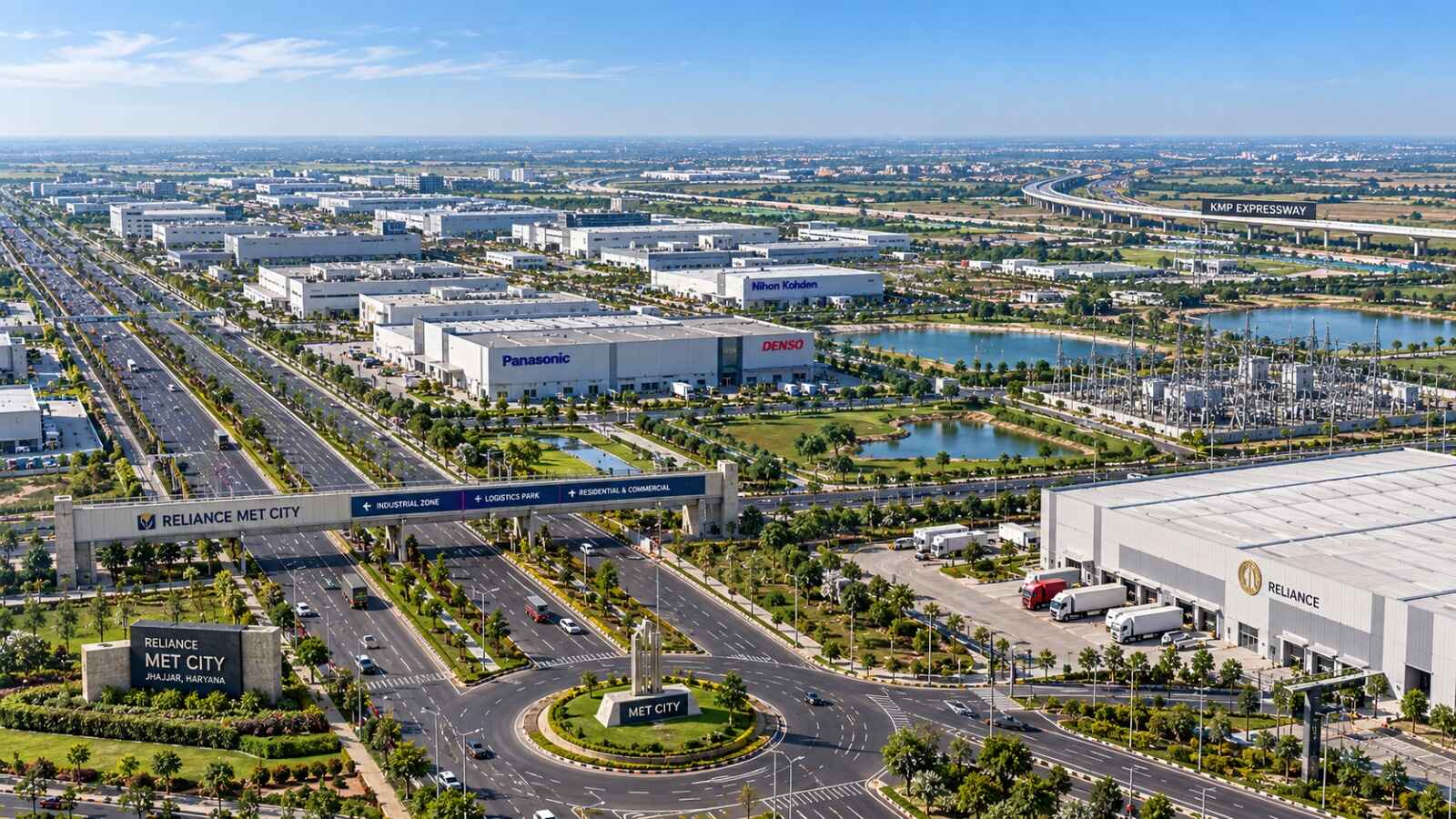
That combination is rare in Haryana’s real estate landscape, but it is also easy to overpay for. The industrial spine is operational—anchored by Japanese manufacturing giants, private utilities including a 220 kV GIS substation, and KMP Expressway connectivity. However, entering residential plots like Metropolis by MET City at ₹99,000–₹1,10,000 per sq yard already prices in significant future optimism.
Understanding whether MET City represents an institutional investment or an illiquid structural trap requires separating industrial payroll from residential livability.
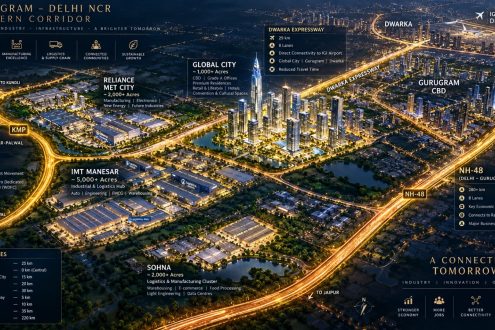
Model Economic Township (MET City) is an integrated industrial city located in Jhajjar district, Haryana, spanning the revenue estates of Daryapur, Dadri Toe, and adjoining villages.
The operating footprint is structured across three core layers:
Most peripheral real estate launches sell speculative “upcoming connectivity”. MET City is one of the few greenfield fringe markets in North India where active enterprise payroll already exists:
The launch of the 140-acre Metropolis by MET City (Phase 1 ~100 acres at Daryapur) introduces residential plots into an industrial ecosystem:
| Product Category | Indicative Ticket / Price | Worked Example | Institutional Read-Through |
|---|---|---|---|
| Metropolis Residential Plot | ₹99,000 – ₹1,10,000 / sq yd | 150 sq yd plot @ ₹1.045 Lakh = ₹1.57 Crore (land only) | Already reflects a mid-NCR ticket; not a distressed agricultural fringe valuation. |
| Built Villa / Independent Floor | ₹2,800 – ₹4,200 / sq ft (construction cost) | 1,800–2,200 sq ft built = +₹0.55–₹0.90 Cr | All-in completed home lands between ₹2.1 – ₹2.5 Crore before interiors. |
| Licensed Industrial Plot | ₹36,000 – ₹44,000 / sq m | 2,000 sq m plot = ₹8.0 Crore | Business underwriting asset; valued on operational yield, not housing speculation. |
| Dwarka Expressway Circle Rates | ~₹66,000 – ₹70,000 / sq yd (circle base) | Varies by specific sector | Demonstrates that Metropolis list pricing is not cheap relative to urban benchmarks. |
The Conversion Trap:
₹1,00,000 per sq yard equals ~₹11,111 per sq ft of raw land area.
Comparing that directly to a Gurugram high-rise apartment at ₹13,000/sq ft
super area is misleading—they represent entirely different density profiles,
civic stacks, and resale liquidity depths.
Four years is too brief a window for greenfield plotted land to deliver speculative flip profits. Applying three scenario CAGRs to the launch midpoint of ₹1,04,500 / sq yd highlights the sensitivity of capital:
Four years is too brief a window for greenfield plotted land to deliver speculative flip profits. Applying three scenario CAGRs to the launch midpoint of ₹1,04,500 / sq yd highlights the sensitivity of capital:
| Valuation Scenario | 4-Year CAGR | Underwriting Conditions | Land Price (2030) | 150 sq yd Value |
|---|---|---|---|---|
| Bear: “Brochure Freeze” (30% Weight) | 4.0% | Slow social infrastructure, thin secondary resale, rate pressure, industrial capex pause. | ₹1,22,300 / sq yd | ₹1.83 Crore |
| Base: “Industrial City Matures” (45% Weight) | 10.0% | Manufacturing jobs compound, Metropolis absorbs, Haryana Orbital Rail progresses. | ₹1,53,000 / sq yd | ₹2.29 Crore |
| Bull: “Western NCR Re-Rating” (25% Weight) | 16.0% | Major rail transit surprise, additional global OEM entry, rapid circle rate catch-up. | ₹1,89,200 / sq yd | ₹2.84 Crore |
*All figures represent land price scenarios only, based on mid-launch anchor of ₹1,04,500/sq yd. Excludes holding costs, EDC/IDC, club charges, and construction.
The Friction Factor: In the Base scenario, a ₹1.57 Cr investment marks at ₹2.29 Cr by 2030—a nominal ₹72 Lakh gain. After deducting 6%–8% in round-trip transaction costs, plot maintenance levies, and factoring an alternate 7% annual opportunity cost of capital, economic real profits remain in the low single digits. In the Bear scenario, capital experiences negative real returns.
A 20-year land-holding thesis must account for the natural step-down in growth rates as large master plans transition from speculative discovery to mature suburban status:
| Path (2026 to 2050) | 2030 Base Node | 2030–50 CAGR | 2040 Projected | 2050 Projected | 150 sq yd Value (2050) | 24-Yr Blended CAGR |
|---|---|---|---|---|---|---|
| Bear City + Slow Maturation | ₹1,22,300 | 3.5% | ₹1,72,600 | ₹2,43,600 | ₹3.65 Crore | 3.6% |
| Base City + Inflation-Plus | ₹1,53,000 | 5.5% | ₹2,61,300 | ₹4,46,300 | ₹6.69 Crore | 6.2% |
| Base City + Strong Suburb | ₹1,53,000 | 7.0% | ₹3,01,000 | ₹5,92,200 | ₹8.88 Crore | 7.5% |
| Bull City + Mature Stabilization | ₹1,89,200 | 5.5% | ₹3,23,100 | ₹5,51,800 | ₹8.28 Crore | 7.2% |
*All 2040 and 2050 rupee values are nominal. 150 sq yd calculations represent unencumbered land values without construction or holding cost deductions.
The Inflation Reality: In the Base path, a 150 sq yd plot expanding from ₹1.57 Cr to ₹6.69 Cr yields a 6.2% nominal CAGR. Deflated at a 4.0% to 5.0% consumer inflation rate, the real compounding rate sits between 1.1% and 2.1%. Over generational horizons, peripheral land acts as wealth preservation rather than venture-capital-style windfalls.
| Underwriting Parameter | Ground Evidence & Reality | Firm Mark |
|---|---|---|
| Promoter Solvency & Balance Sheet | 100% RIL subsidiary; strong credit backing, capital deployment >₹10,000 Cr. | HELP |
| On-Ground Economic Engine | 600+ industrial firms, Japan cluster, 40,000+ active workforce. | HELP |
| Trunk Engineering Utilities | 220 kV GIS substation, wide paved road grids, dedicated WTP networks. | HELP |
| Entry Residential Pricing | ₹99k–₹1.10L/sq yd embeds smart-city premiums without an urban social fabric. | HURT |
| Secondary Market Liquidity | Peripheral plotted pockets resell slowly; end-user depth is still emerging. | HURT |
| Immediate Social Infrastructure | AIIMS Badsa nearby; daily shopping, schools, and healthcare within the fence remain thin. | HURT |
| Future Competing Supply | Thousands of yet-to-be-licensed acres held by promoter; future phases will compete with resales. | HURT |
| Long-Horizon Optionality | 8,000-acre master plan offers strategic exposure to Western NCR freight growth. | HELP |
*Forensic risk marks assigned from the perspective of an individual plotted residential investor entering at list launch price.
Access independent RERA due diligence packs, industrial land valuation models, and pocket-level micro-market verification for Western NCR corridors:
Statutory & Research Disclaimer: This report is compiled by SS Estate Analytica solely for educational, research, and informational purposes as of September 2026. It does not constitute an offer to sell, a valuation certificate under the Companies Act, or formal investment advisory under SEBI regulations. Forward-looking scenario projections represent hypothetical models subject to market cyclicality, policy shifts, and developer execution. Investors must conduct independent title, legal, and financial checks before committing capital.