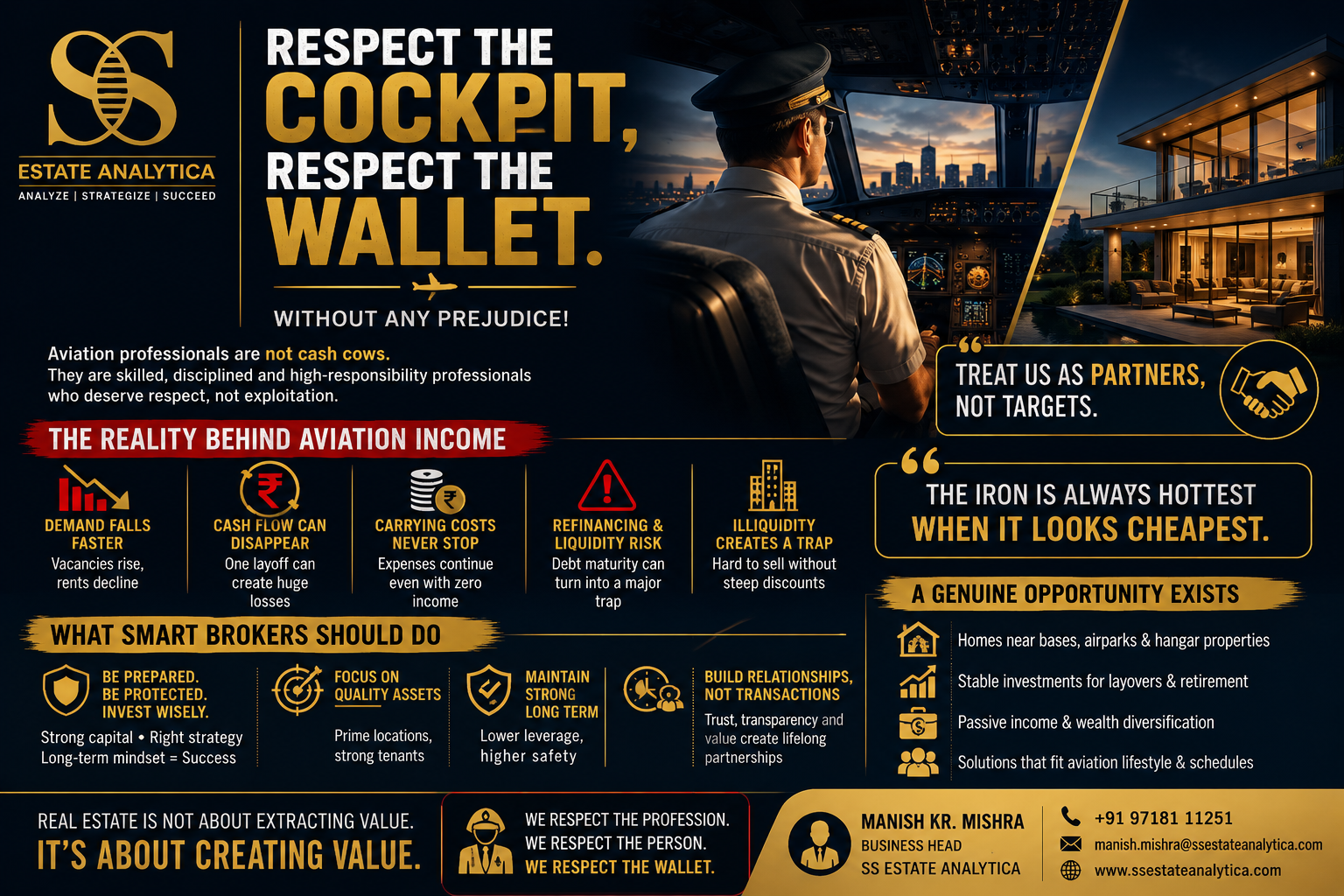
Why Aviation Professionals Deserve Better from the Real Estate Industry
Without Any Prejudice
For years, a perception has quietly existed within parts of the aviation community: that real estate brokers often view aviation professionals as “cash cows” rather than informed clients.
As someone who has closely observed both industries, I believe this mindset has contributed significantly to a trust deficit between aviation professionals and segments of the real estate sector.
Pilots, captains, first officers, flight engineers, air traffic controllers, and senior cabin crew members deserve the same level of respect, transparency, and professional treatment as any other client—not because of their income, but because of the expertise, discipline, and sacrifices their profession demands.
The Problem with the “High-Earner” Label
Aviation professionals are frequently perceived as ideal targets for premium property sales because many enjoy stable and respectable incomes, particularly at senior levels.
However, reducing an entire profession to purchasing power is both shortsighted and counterproductive.
Aviation professionals are not impulsive buyers.
They are trained decision-makers who operate in high-stakes environments where precision, risk assessment, and accountability are non-negotiable. These are individuals who:
- Conduct extensive research before making decisions.
- Analyze risks and returns carefully.
- Value facts over marketing hype.
- Recognize pressure-selling tactics immediately.
- Prioritize long-term value over emotional purchases.
When brokers treat aviation professionals as easy sales opportunities, the result is often mistrust rather than transactions.
The Reality Behind Aviation Income
The assumption that aviation professionals have “easy money” could not be further from reality.
Behind every paycheck lies:
- Irregular work schedules.
- Long periods away from family.
- Strict regulatory oversight.
- Continuous training and evaluations.
- Physical and mental fatigue.
- Medical certification risks.
- Industry volatility.
History has repeatedly shown how external events can disrupt aviation careers overnight. Whether it was the aftermath of 9/11, economic downturns, or the COVID-19 pandemic, aviation professionals understand uncertainty better than most.
This is precisely why many pilots and aviation professionals invest in real estate—not for luxury, but for diversification, financial security, and long-term wealth preservation.
A Genuine Real Estate Opportunity Exists
To be clear, there is nothing wrong with marketing real estate solutions to aviation professionals.
In fact, there is a natural overlap between the two industries.
Many aviation professionals seek:
- Homes near operational bases and airports.
- Investment properties that generate passive income.
- Retirement-focused real estate assets.
- Airpark communities and hangar homes.
- Flexible investment opportunities compatible with demanding schedules.
These needs create legitimate opportunities for real estate professionals who understand the aviation lifestyle.
The issue arises when marketing shifts from serving needs to exploiting perceived income levels.
Aggressive campaigns targeting pilots solely because they are viewed as high-income earners often appear predatory and damage credibility.
What Smart Real Estate Brokers Should Do Instead
1. Focus on Value, Not Income
The most successful brokers understand that every client has unique goals.
Instead of focusing on what a client earns, focus on:
- What they want to achieve.
- Their risk tolerance.
- Their investment horizon.
- Their family and lifestyle priorities.
2. Understand the Aviation Lifestyle
Knowledge creates trust.
Real estate professionals serving aviation clients should understand:
- Crew scheduling realities.
- Base transfers and relocations.
- Time-zone challenges.
- Retirement planning considerations.
- Aviation-specific property preferences.
Clients appreciate advisors who understand their world.
3. Build Relationships, Not Transactions
Real estate is fundamentally a relationship business.
A pilot who receives honest guidance today may become:
- A repeat client tomorrow.
- A long-term investor partner.
- A source of referrals across the aviation community.
Aviation remains a tightly connected professional network where reputation travels quickly through crew rooms, associations, social groups, and professional circles.
4. Act as an Advisor
The future belongs to brokers who position themselves as trusted advisors rather than commission-driven salespeople.
Aviation professionals value:
- Transparency.
- Expertise.
- Data-driven recommendations.
- Ethical conduct.
- Long-term thinking.
Provide those consistently, and trust follows naturally.
The Bigger Picture
Doctors, engineers, executives, entrepreneurs, and aviation professionals all share one common expectation: they want to work with professionals who respect both their intelligence and their financial decisions.
Real estate should never be about extracting maximum value from a client.
It should be about creating maximum value for a client.
When brokers approach aviation professionals with integrity, knowledge, and genuine service, both industries benefit.
When they approach them as revenue targets, trust disappears.
The choice is simple.
Respect the profession. Respect the person. Respect the wallet.
And above all—
Respect the Cockpit, Respect the Wallet.
Best Regards,
Manish Kr. Mishra
Business Head
SS Estate Analytica
Mobile: +91 97181 11251